Measure & Myth
How Exact Does a Birth Time Need to Be?
Western houses, Jyotiṣa charts, Four Pillars, and date-based methods use different parts of a birth record. Their time boundaries differ too.
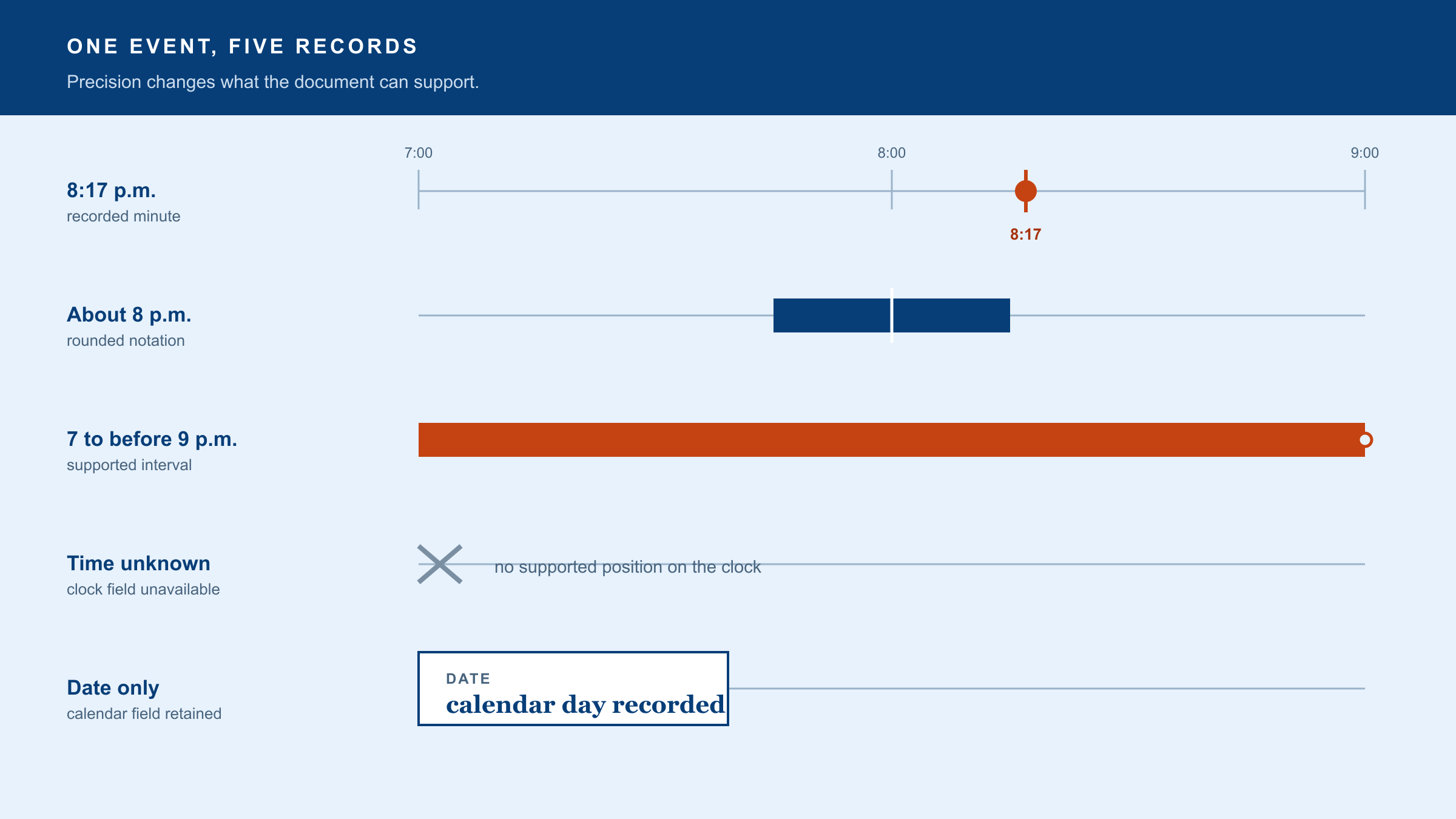
A birth record gives 8:17 p.m. Western chart software can use that minute to calculate an Ascendant and house cusps for a stated place. A Four Pillars table places it in the Xu hour, the two-hour range from 7 to 9 p.m. A Chinese zodiac year animal does not use the time of day. The numerology method in a 1926 English-language manual asks for a name and birth date instead.
The useful unit comes from the calculation. “Exact” might mean a documented minute, the correct side of a house boundary, the correct two-hour branch, or simply the right calendar date. A record can be adequate for one output and insufficient for another.
What changes as the record gets less precise?
Each row names the output affected by missing clock time.
Western natal chart
- 8:17 p.m.Angles and houses calculated
- About 8 p.m.Calculate a range
- 7 to before 9 p.m.Angles may vary substantially
- Time unknownOmit angles and houses
- Date onlyMany planet positions remain
Parashara's Light example
- 8:17 p.m.Lagna, Navamsha, and dasha balance calculated
- About 8 p.m.Change Time tests the recorded interval
- 7 to before 9 p.m.Change Time tests the full two hours
- Time unknownNo supported timed worksheet
- Date onlyDate retained; timed outputs withheld
Four Pillars
- 8:17 p.m.Xu hour in the HKO table
- About 8 p.m.Same range if before 9
- 7 to before 9 p.m.One defined hour range
- Time unknownHour pillar unavailable
- Date onlyYear, month, and day remain
Year animal
- 8:17 p.m.Time of day unused
- About 8 p.m.Time of day unused
- 7 to before 9 p.m.Time of day unused
- Time unknownYear boundary still matters
- Date onlyYear branch available
Taylor numerology
- 8:17 p.m.Time of day unused
- About 8 p.m.Time of day unused
- 7 to before 9 p.m.Time of day unused
- Time unknownName and date still used
- Date onlyName and date calculation
Precision belongs to a particular output
People often ask whether an exact birth time is required “for astrology.” The question joins together several chart systems and all the information within a chart.
A more precise question names an output. Is the goal to calculate Western houses? The Lagna in a Jyotiṣa chart? A Four Pillars hour sign? A zodiac year animal? A value derived from a birth date? Each calculation has its own inputs and boundaries.
Precision also has two parts. The resolution tells us how finely the time was recorded: minute, quarter hour, hour, part of day, or unknown. The accuracy tells us how closely that notation corresponds to the event. A certificate can print 8:17 even if the time was rounded, copied, or entered after a delay.
Before comparing methods, the record needs a date, place, and civil-time rule. An old local clock reading may require historical reconstruction. A daylight transition can make some local readings repeat or disappear. The first story in this publication, “Before the Time Zone, What Time Were You Born?”, explains that part of the work.
Western houses use time and place
The Swiss Ephemeris is a widely used astronomical calculation library. Its house function receives a Julian date in Universal Time, geographic latitude, geographic longitude, and a selected house system. It returns the house cusps, Ascendant, Midheaven, and related points.
Those inputs show why the recorded clock time needs conversion. 8:17 p.m. at the birthplace must first become the corresponding Universal Time under the civil rule in force. Latitude and longitude place the local horizon. The chosen house system determines how the chart divides the space into houses.
The Ascendant is the ecliptic point rising at the eastern horizon. The Midheaven and house cusps are also tied to the sky’s orientation for that time and location. They change continuously as Earth rotates. Their rate of change is not a universal one degree every four minutes; it varies with latitude, the part of the ecliptic rising, and the geometry of the calculation.
Planet positions also change with time, though most move far more slowly across a single day than the chart angles. A date-only chart can therefore retain useful astronomical positions while omitting the Ascendant and houses. The Moon requires more care because it moves roughly thirteen degrees per day and may cross a sign boundary while the unknown hours pass.
Astro-Databank provides one concrete operational convention. When a birth time or place is unknown, its records do not display an Ascendant and do not claim an exact Moon degree. Other astrologers and software may display a noon chart or use an “unknown time” setting. The presentation should make the limitation visible.
If a record says “about 8 p.m.,” calculate the supported range. Comparing 7:45, 8:00, and 8:15 shows whether a house cusp or angle changes enough to affect the proposed reading. Selecting one minute from the middle of the range would give the software more certainty than the document supplies.
One Jyotiṣa program exposes several time-sensitive calculations
Jyotiṣa is the term used here for Indian astral traditions often called Vedic astrology in English. Practices and settings vary, so this comparison uses one documented implementation: Parashara’s Light 9.0.
The manual’s Change Time tool can move a birth time by years, months, days, an Ascendant, a Navamsha, hours, minutes, seconds, or other steps. A worksheet can display a birth chart, Navamsha, and Vimshottari dasha information while the user changes the proposed time.
The documentation supports a method for testing an uncertainty interval. It does not establish one accuracy threshold for every output or school. A reported result needs to identify the worksheet output, selected ayanāṃśa, divisional-chart rule, dasha method, and the times that were compared.
“Jyotiṣa needs the exact minute” leaves the intended calculation unspecified. A checkable analysis states the school or software settings, tests the supported time range, and reports which displayed outputs changed.
Birth-time rectification is a separate interpretive practice. Practitioners compare possible times with life events or other chart factors and select a proposed time. That process does not improve the original record. Its result should be identified as a rectified time, with the method and uncertainty stated.
Four Pillars assigns the time to a double hour
The Hong Kong Observatory explains the Heavenly Stems and Earthly Branches used to record years, months, days, and hours. Together the four stem-branch pairs form the Eight Characters used in Four Pillars methods.
The hour unit is the shichen, often translated as a double hour. The Observatory maps twelve branches to modern clock ranges. Zi runs from 11 p.m. to 1 a.m., Chou from 1 to 3 a.m., and the sequence continues in two-hour blocks. Xu runs from 7 to 9 p.m. The recorded time 8:17 p.m. therefore falls within Xu under that table.
The branch does not require the minute once the correct range is secure. A note saying “between 7 and 9 p.m.” supplies the same branch. A less specific memory such as “around 9 p.m.” crosses the boundary between Xu and Hai and leaves two possible hour branches.
The hour stem adds another dependency: it is derived from the day’s stem. Date calculation and the rule for the day boundary must already be settled. The Hong Kong Observatory table establishes the modern clock ranges used in this example. Any alternate time correction requires a separate source and a named method.
When the time of day is unknown, the year, month, and day pairs can still be calculated under the selected calendar rules. The hour pair remains open. Presenting three pillars and a blank hour position is more accurate than filling the gap with a default noon.
A year animal uses the date, not the hour
The familiar Chinese zodiac animal corresponds to the Earthly Branch of a year. The clock time does not enter that assignment. Someone born at 2 a.m. and someone born at 8 p.m. on the same ordinary date receive the same year animal under the same calendar convention.
The boundary can still matter. The Hong Kong Observatory changes the Gan-Zhi year on the first day of the first Chinese month. Some fortune-telling calendars use Spring Commences. A birth near those dates needs the convention stated even though its minute does not matter.
This is the distinction explored in “What a Zodiac Animal Leaves Out”. A year animal uses one part of the birth date. Four Pillars adds the month, day, and hour pairs. The second method asks more of the record because it calculates more positions.
Some numerology methods stop at the calendar date
Ariel Yvon Taylor’s Numerology Made Plain, published in 1926 and digitized by the Library of Congress, demonstrates an English-language name and date method. It assigns values to letters, totals parts of a name, and reduces the month, day, and year of birth according to its rules.
No hour or minute appears in that birth-date calculation. A certificate with an unknown time still contains the fields this method requests, provided the name and date are established.
Other numerology schools may define different inputs and reduction rules. The general label cannot supply those details. A reader needs the actual table or manual before deciding what the method requires.
This comparison establishes which record fields Taylor’s calculation consumes; it does not test the resulting interpretations.
Boundaries make uncertainty consequential
A small uncertainty matters when it straddles a relevant boundary. The size of that boundary depends on the output.
- A few minutes may move a Western house cusp or a fine Jyotiṣa division across a threshold.
- A Four Pillars hour branch remains stable across most of its two-hour range and becomes uncertain near the transition.
- A year animal ignores the clock while remaining sensitive to the selected new-year boundary.
- Taylor’s date and name calculation ignores the clock and depends on the calendar date and chosen spelling.
An uncertainty interval is therefore more useful than a confidence adjective. “Recorded to the minute” describes the notation. “Probably between 8 and 8:30 p.m.” states the supported range. “Before or after 9 p.m. is unresolved” identifies the boundary that affects the Four Pillars hour sign.
Software can evaluate the endpoints and any boundary inside that range. The output can then separate stable information from values that vary.
Ask what the calculation needs
Five questions turn a vague request for an exact time into a checkable one:
- Which output are you calculating? Name the angle, house, Lagna, divisional chart, hour pillar, year animal, or number.
- Which record fields does it use? Date, clock time, location, name, script, and calendar may enter separately.
- What is the nearest relevant boundary? Test the uncertainty range on both sides of it.
- Which settings belong to the method? House system, ayanāṃśa, day boundary, civil-time correction, and reduction table can change a result.
- What remains available when a field is missing? Omit unsupported outputs and preserve the calculations that the record can sustain.
A recorded minute is valuable when its provenance supports it. A rounded hour or unknown time can still answer other questions. Use the method to identify the necessary fields, then limit the result to the accuracy supported by the record.
Sources and notes
- Astrodienst, Swiss Ephemeris Programmer’s Manual, section 15. Inputs and outputs for house cusp, Ascendant, and Midheaven calculations.
- Astrodienst, “Swiss Ephemeris.” Technical overview of ephemeris, sidereal-time, angle, and house calculations.
- Astro-Databank, “Astroinfo.” Operational treatment of records with an unknown birth time or place.
- Ptolemy, Tetrabiblos, Book III, University of Chicago edition. Historical discussion of birth-time and ascendant uncertainty.
- Parashara’s Light 9.0 user manual. Contemporary practitioner software documentation for changing and rectifying birth time.
- Parashara’s Light feature documentation. Lagna, houses, divisional charts, dashas, and dasha-balance options.
- Hong Kong Observatory, “Heavenly Stems and Earthly Branches.” The Eight Characters and the twelve shichen mapped to modern time ranges.
- Hong Kong Observatory, “The 12-Year Animal Cycle.” Year animals and their Earthly Branches.
- Hong Kong Observatory, “What year is it today?” Chinese calendar and Spring Commences boundary conventions.
- Ariel Yvon Taylor, Numerology Made Plain (1926), Library of Congress. Public-domain name and birth-date calculation manual.
- IANA, “Theory and pragmatics of the tz code and data.” Civil-time rules and historical data limitations.
- U.S. Naval Observatory, “The Equation of Time.” Apparent solar, mean solar, and civil time.