Under Many Skies
One Birth, Several Records
A name, date, clock time, and place change form as they move from a birth worksheet into official files and later calculations.
The first row of the 2003 U.S. Standard Certificate of Live Birth asks for a child’s name, time of birth, sex, and date of birth. The next row records the facility, city or location, and county. Parent information, certification, administrative data, and medical details occupy the rest of the form.
Those entries do not remain in one document. Some become part of a legal record. Some enter state and national statistical files. Years later, a person may copy the date, time, place, or name into a chart program or a number table. Each transfer keeps a selection of the original fields and changes their form.
The fields that reach each record
Four methods begin with different selections from one certificate.
- Civil registrationU.S. standard certificateUses
- Name
- Date
- Time
- Place
- Sex
- Parents
- Medical
Does not useNone of these selected fields
Produces a legal and statistical record
- Western natal chartHouse calculationUses
- Date
- Time
- Place
Does not useName, sex, parents, medical details
Produces positions, angles, and houses
- Four PillarsCalendar conversionUses
- Date
- Time
Does not useName, place, sex, parents, medical details
Produces year, month, day, and hour pairs
- Name and date numberTaylor, 1926Uses
- Name
- Date
Does not useTime, place, sex, parents, medical details
Produces letter and date totals
The certificate begins with other records
Birth registration is the official act of recording a birth with a government authority. A birth certificate is the document issued as evidence that registration occurred. UNICEF uses this distinction because registration can exist even when a family never receives a paper certificate.
Article 7 of the United Nations Convention on the Rights of the Child connects registration after birth with rights to a name and nationality. National and local laws determine the procedure, deadlines, fields, and documents that follow. A form used in one jurisdiction cannot stand for every civil registration system.
The U.S. standard certificate provides one example of how a government record is assembled. Its first section identifies the child and states when and where the birth occurred. Parent and certifier sections connect the child to other people and to the person who attests to the record. Additional fields serve administration, public health, and national statistics.
The CDC’s facility worksheet guide identifies preferred sources for individual fields. Information may come from the medical record, the mother, or the person completing the worksheet, depending on the item. The certificate brings these entries together after they have already passed through hospital documentation and human reporting.
A clock reading becomes a data value
The time field has its own data rules. CDC specifications define it as the hour and minute of birth, preferably written from 0000 through 2359. A birth recorded at 8:17 p.m. becomes 2017 in that format.
An unknown time follows a different route. The certificate can contain Unknown, and the national transmission file receives 9999. CDC assigns that code when no supported clock value was supplied.
This treatment of missing information matters because a four-digit field can otherwise look complete. 2017 and 9999 have the same width in a data file, but only the first encodes a clock reading. The edit specification gives the second value a separate meaning.
Place changes from words to coordinates
On the certificate, birthplace appears as a facility, city or location, and county. Those words answer administrative questions about where the birth occurred. A Western house calculation needs another representation of place: geographic latitude and longitude.
The clock reading changes too. The Swiss Ephemeris house function receives a date expressed in Universal Time, coordinates, and a selected house system. Software has to associate the recorded place and date with the civil-time rule then in force before it can make that conversion. The certificate supplies evidence for the input, while the coordinates, Universal Time value, and house-system setting enter later.
This chain creates several opportunities for correction. A misspelled town can resolve to the wrong coordinates. A historical time-zone rule can be selected incorrectly. A software setting can change without altering the certificate. Keeping the original fields beside the converted values makes those decisions inspectable.
Date, time, and name can travel separately
Later systems do not necessarily reuse the same bundle. The Hong Kong Observatory describes Heavenly Stems and Earthly Branches paired for year, month, day, and hour. A Four Pillars output therefore transforms calendar and clock fields into four pairs. Under the Observatory’s modern clock table, 8:17 p.m. falls within the Xu double hour, which runs from 7 to 9 p.m.
Ariel Yvon Taylor’s 1926 Numerology Made Plain follows another route. Its tables assign values to letters of the English alphabet and total parts of a written name. A separate procedure works with the month, day, and year of birth. The demonstrated method has no field for birthplace or clock time.
Name spelling can change after registration through correction, adoption, marriage, transliteration, or ordinary preference. A later number calculation therefore needs to identify which written form it used. The original certificate and the later calculation may both be accurately documented even when their name fields differ.
The unused fields still describe the record
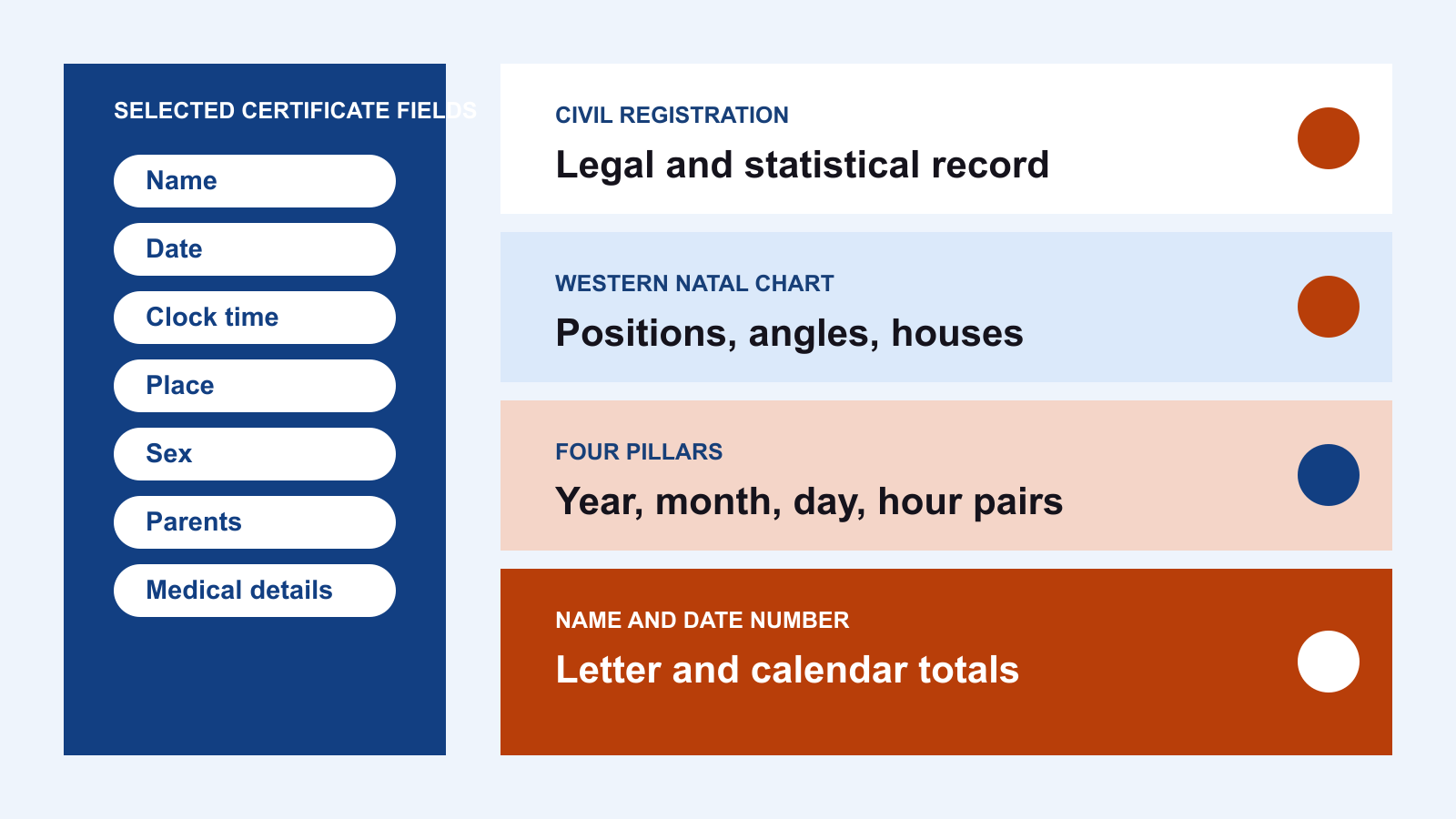
The field map above compares seven selected parts of the U.S. certificate. Civil registration uses all seven. The Western house calculation uses date, time, and place. The Four Pillars example uses date and time. Taylor’s procedure uses name and date.
Sex, parent information, and medical details remain outside all three later calculations. They stay within the administrative record and mark the limits of each later form.
The distinction between supplied and calculated values is equally important. A certificate supplies a place name. A geocoder supplies coordinates. Time-zone rules convert a local reading. An ephemeris calculates positions and angles. A final chart can display all of them together even though they entered at different stages.
What 9999 preserves
In the CDC transmission file, 9999 records the absence of a supported birth time. A Western house calculation cannot recover an Ascendant from that code. The Four Pillars hour pair remains unresolved. Taylor’s name and date procedure can continue because it never requests the time field.
The code preserves a boundary between recorded evidence and later inference. Leaving the hour blank may reduce what a calculation can produce, but it keeps an unsupported guess from acquiring the appearance of an official fact. The blank field remains useful information about the record.
Sources and notes
- Centers for Disease Control and Prevention, U.S. Standard Certificate of Live Birth, revised November 2003. Child, time, date, place, parent, certification, administrative, and medical fields.
- CDC, Birth Edit Specifications for the 2003 Revision. Time, date, place, missing-value, and transmission rules.
- CDC, Guide to Completing the Facility Worksheets. Current definitions and preferred sources for certificate fields.
- United Nations, Convention on the Rights of the Child, Article 7. Registration after birth, name, and nationality.
- UNICEF, “Birth registration.” The distinction between registration and the certificate issued after it.
- Astrodienst, Swiss Ephemeris Programmer’s Manual, section 15. Inputs and outputs for houses, Ascendant, and Midheaven.
- Hong Kong Observatory, “Heavenly Stems and Earthly Branches.” The Eight Characters and twelve double hours.
- Ariel Yvon Taylor, Numerology Made Plain (1926), Library of Congress. Letter values and name and birth-date calculations.
- UNICEF Data, Civil Registration and Vital Statistics. Country profiles showing differences in registration systems.