Time Has Character
When Does Your Year Begin?
Civil calendars, festivals, birthdays, seasons, and astrological returns place the start of a year at different moments for different purposes.
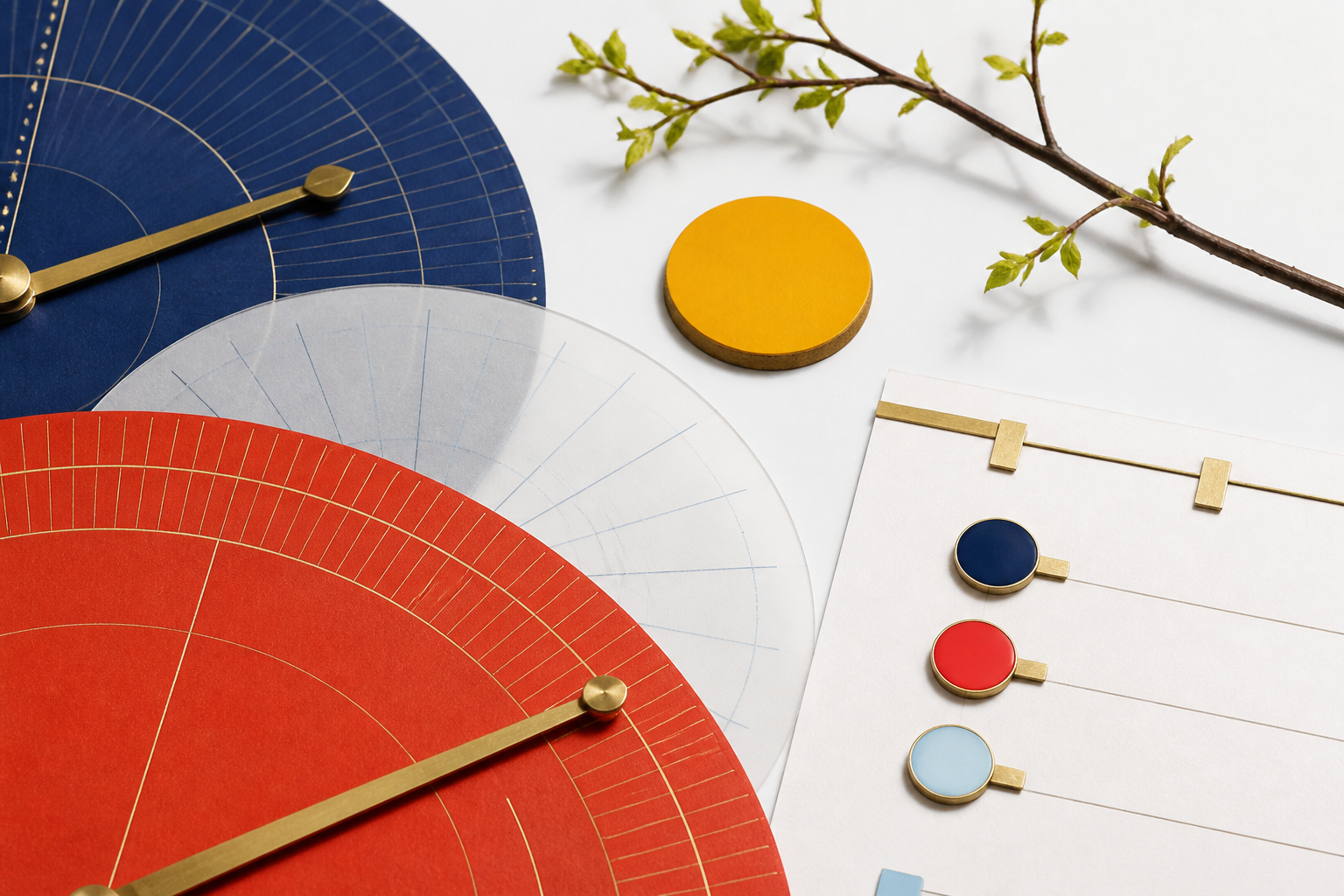
January 1 begins the year printed at the top of a Gregorian calendar. In Hong Kong’s official 2026 Chinese calendar, the Bing-Wu year began on February 17. Nowruz marks the arrival of spring. A birthday advances a person’s age under common civil rules. Astrologers calculate a solar return near that date.
Those dates begin different kinds of year. January 1 organizes civil records and budgets. A lunisolar calendar keeps months connected to lunar phases while staying aligned with a solar seasonal cycle. Nowruz carries communal practice and seasonal meaning. A birthday counts completed years of life. A solar return follows a calculated position of the Sun.
Several ways a year can start
Each boundary begins a different count.
- Gregorian civil yearCalendar year used for civil dates and records
- Chinese calendar yearThe 2026 date in Hong Kong’s official calendar
- SpringNowruzNew year and the first day of spring
- Your dateBirthdayA personal age boundary in full-year counting
- Near itSolar returnThe Sun reaches its natal position in an astrological calculation
January 1 is a civil boundary
The Gregorian date changes from December 31 to January 1 everywhere that uses the calendar, although midnight arrives at different instants around the world. Governments, schools, businesses, and families attach many annual counts to it. Other counts begin on a tax date, an academic term, or an anniversary.
January 1 has a history. In England before 1752, people celebrated it as New Year’s Day while the legal year used for many records began on March 25. The Calendar (New Style) Act moved the legal start of the year to January 1 and adopted the Gregorian calendar in Britain and its colonies.
That change is one reason historical dates sometimes appear in “Old Style” and “New Style” forms. The start of the numbered year depended on the dating convention used by the record. Other countries changed calendars on different schedules.
The calendar also needs leap rules because a solar year is about 365.2422 days. The Gregorian pattern adds February 29 in years divisible by four, except century years that are not divisible by 400. Royal Museums Greenwich explains how this keeps calendar months from drifting steadily through the seasons.
The Chinese calendar begins on a moving Gregorian date
The Chinese calendar described by the Hong Kong Observatory combines two kinds of cycle. A month follows changes in the Moon and has 29 or 30 days. The twenty-four solar terms follow the tropical year. A normal year has twelve months, while a leap year adds a thirteenth month when required.
The Observatory marks the start of the Gan-Zhi year on the first day of the first Chinese month. Its explanation places that day at the second new moon after the winter solstice, with a provision for a leap month. The resulting New Year’s Day falls on different Gregorian dates.
In 2026, Hong Kong listed Chinese New Year’s Day on February 17. January 1 had already begun the Gregorian civil year. The date February 17 began the Bing-Wu year in the official Chinese calendar.
Some fortune-telling calendars use the solar term Spring Commences as the Gan-Zhi changeover. The Observatory describes this convention alongside the rule used in its official calendars. A precise statement about the year therefore names both the calendar and the authority or practice.
The calculated date sits alongside regional, national, family, and religious customs, all of which vary.
Nowruz starts with spring
Nowruz means “new day.” UNESCO describes it as an ancestral festivity marking the first day of spring and the renewal of nature. Its rituals include meals, visits, gifts, clothing, music, and other forms that vary among communities.
The celebration spans the Balkans, Black Sea Basin, Caucasus, Central Asia, the Middle East, and other regions. Afghanistan, Azerbaijan, India, Iran, Iraq, Kazakhstan, Kyrgyzstan, Pakistan, Tajikistan, Turkey, Turkmenistan, and Uzbekistan jointly supported its inscription on UNESCO’s Representative List of the Intangible Cultural Heritage of Humanity.
UNESCO observes the International Day of Nowruz on March 21. Local names, calendars, and customs vary, and some calculations attend closely to the equinox. The seasonal reference gives this new year a different basis from January 1 or the first day of a lunar month.
The phrase “spring New Year” introduces the seasonal link. UNESCO’s record of local names and forms also points to the different histories and practices of the communities that celebrate it.
A birthday begins a year of age
For many official purposes, a person begins at age zero and adds one completed year on each birthday. The date is personal, so people born on different days cross the boundary at different times.
South Korea provides a recent example of how age systems can change while birth dates remain the same. In June 2023, the country standardized many civil and administrative uses around full-year age: start at zero and add a year at each birthday. The policy aimed to reduce confusion among several counting methods, although some statutes continued to use their own rules.
Birthday observance also has its own history. Jean-Claude Schmitt’s study of the emergence of birthday celebration in Europe shows an uneven development through the medieval and early modern periods. That history concerns Europe and should not be treated as a universal account of birthdays.
Modern institutions use a birthday for many transitions: voting age, school eligibility, pension rules, insurance categories, or an age printed on an identification document. The exact legal effect depends on jurisdiction. In each case, the anniversary starts a new count for one person.
A solar return may fall at a different clock time
In Western astrological practice, a solar return is calculated for the instant when the transiting Sun reaches the position it held in a natal horoscope. It usually falls close to the civil birthday, with the exact clock time shifting from year to year.
This is a technical definition within an astrological tradition. AstroLibrary’s reference entry describes the calculation and its use for an annual horoscope. Schools and practitioners differ over location, house system, precession, and interpretation.
A birthday follows the recurring civil month and day. A solar return uses an astronomical position interpreted through astrological practice. Someone born late on August 10 might have a later return on August 10 in one year and an earlier one in another, depending on the calculation.
When an app or reading says a “personal year” has begun, the date might come from a birthday, a solar return, a numerological cycle, a profection, or another technique. Naming the technique resolves the ambiguity.
One calendar can contain several new years
Different boundaries can also appear inside a single textual tradition. Mishnah Rosh Hashanah 1:1 opens with four new years used for distinct legal and ritual counts.
The first of Nisan governs kings and festivals. The first of Elul is assigned to the tithe of cattle, with a recorded disagreement. The first of Tishrei begins counts for years, sabbatical and jubilee years, planting, and vegetables. The school of Shammai gives the first of Shevat as the new year for trees, while the school of Hillel gives the fifteenth.
The text in translation is concise because its readers know the larger legal discussions. Its opening list assigns a boundary to each kind of count.
The same logic appears in secular life. Calendar year, fiscal year, school year, and age year can all be current at once. They start on different dates because institutions use them to organize different records and obligations.
Find the count behind the date
When a calendar, festival, or reading announces a new year, four details make it easier to understand:
- The boundary: Is it a fixed civil date, a lunar date, a seasonal observation, an anniversary, or a calculated return?
- The authority or community: Which government, calendar maker, text, practitioner, or community sets or observes it?
- The thing being counted: Civil years, months, age, agricultural obligations, ritual time, or an astrological period?
- The local variation: Does the date or practice change by location, school, legal rule, or calendar convention?
January 1 remains the ordinary answer in a Gregorian civil setting. A different answer may be required for a Chinese calendar date, a Nowruz observance, a person’s age, or a solar-return chart. Naming the practice tells us which annual boundary the speaker means and what begins there.
Sources and notes
- UK Parliament, “The Calendar.” Britain’s 1752 change to the Gregorian calendar and January 1 legal year.
- Royal Museums Greenwich, “Which years are leap years?” Gregorian leap-year rules and the tropical year.
- Hong Kong Observatory, “What year is it today?” Chinese calendar months, solar terms, leap months, and year-boundary conventions.
- Hong Kong Observatory, Gregorian-Chinese Calendar Conversion Table.
- Hong Kong Observatory, 2026 almanac. The Bing-Wu year and 2026 calendar dates.
- Government of Hong Kong, “General holidays for 2026.” Chinese New Year’s Day on February 17, 2026.
- UNESCO, International Day of Nowruz and decision 4.COM 13.03. Spring, new-year context, geographic range, and local variation.
- Republic of Korea, “Koreans to get 1–2 years younger under revised age system.” Full-year age standardization in 2023.
- Jean-Claude Schmitt, “L’invention de l’anniversaire.” European history of birthday celebration.
- AstroLibrary, “Solar Return, Solar Revolution.” Practitioner-library definition of the astrological calculation.
- Center for Online Judaic Studies, Mishnah Rosh Hashanah 1:1–9. Translation of the four new-year boundaries and related calendar material.