Time Has Character
A Good Time to Begin
Almanacs, birth records, and horoscopic charts narrow the calendar in different ways before a wedding, journey, building, or enterprise begins.
A late-Ming manuscript copy of Snippets on the Three Calendars gives favorable days for weddings, marriage proposals, travel, taking office, construction, moving house, opening a shop, planting, and several other activities. The Library of Congress catalog notes that some months contain no suitable day for a particular undertaking.
The activity comes first. A day marked for travel may not carry the same designation for a wedding or burial. The calendar narrows after the reader states what is about to begin.
Other sources add personal birth information or calculate a horoscope for a proposed starting time. The phrase auspicious date covers several procedures, each with its own texts, calendar units, and social setting.
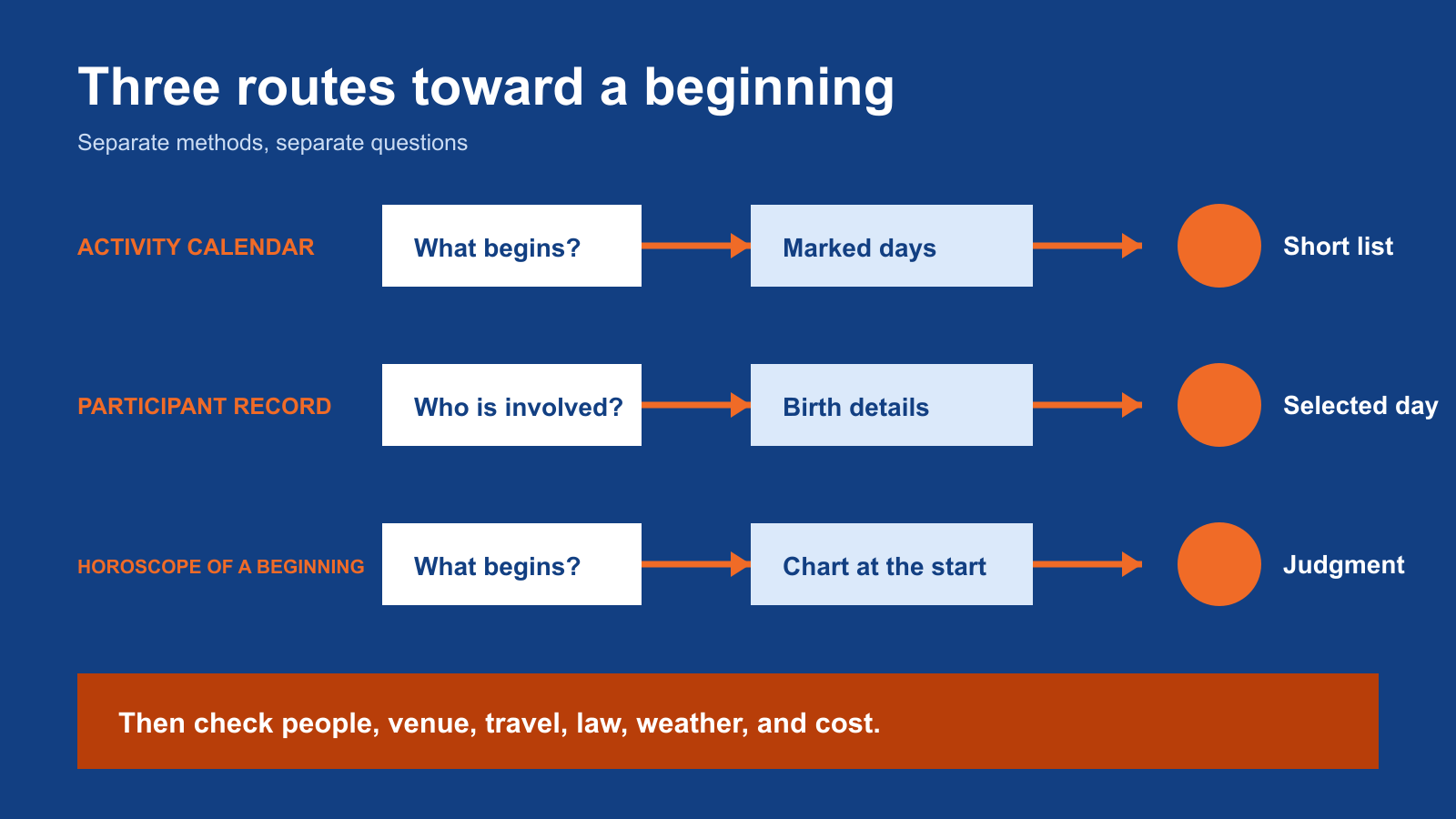
Three routes toward a beginning
Each source asks for different information before a date is used.
Activity calendar
Chinese calendar manuscripts
- Begin withWedding, journey, shop, building
- ConsultDays marked for that activity
- KeepA short list, or none that month
Participant record
Korean wedding letter
- Begin withA proposed marriage
- AddThe groom's Four Pillars
- ReturnA selected wedding day
Horoscope of a beginning
Dorotheus, Book Five
- Begin withA journey, request, or undertaking
- ExamineThe horoscope for its beginning
- RecordA judgment tied to that question
One calendar sorts days by activity
The Library of Congress dates the surviving Snippets on the Three Calendars manuscript to the late Ming period and describes it as a copy of a Song edition. Its three parts combine activity lists, an illustrated long-range calendar, and rhymed instructions concerning favorable and unfavorable times.
The first part resembles a working index. A reader can look for weddings, boarding a ship, starting construction, digging ground, moving into a house, going to market, making wine, going to school, or planting. The catalog describes black circles for the most favorable classifications and white circles for ill-fortune classifications in another part of the work.
The classifications attach to named acts, so one day can carry different guidance for travel, marriage, or burial. A month with no recommended day for an activity also places a limit on the calendar’s answer.
A second Library of Congress artifact, the Newly Compiled Pocket Astrological Calendar, comes from the Yuan period. Its catalog lists assuming office, weddings, construction, moving, and burial among the activities it addresses. It also contains material on yin and yang, directions, the path of Jupiter, the Nine Palaces, and divisions of the solar year.
The small physical format matters. A portable calendar could be consulted in ordinary decisions. The surviving copy also shows that day selection was joined to several calendrical and directional systems within that text. Those systems should not be reduced to the modern label “lucky day.”
A pañcāṅga carries several kinds of time
The Library of Congress holds an illustrated almanac for the Hindu year 1871–1872 from Rajasthan. Its curatorial description calls it a pañcāṅga and explains that such almanacs were used for festival dates and for favorable or unfavorable timing. The illustrated fabric includes deities, planets, zodiacal figures, and Ganesha, who is invoked in connection with auspicious beginnings.
The Sanskrit term pañcāṅga refers to five limbs or parts. Alessandra Petrocchi’s 2017 study of a modern Hindi pañcāṅga names them as tithi (lunar day), vāra (weekday), nakṣatra (lunar mansion), yoga, and karaṇa (half of a lunar day). Her discussion connects these calendrical elements with the selection of a muhūrta, a suitable moment for an undertaking.
The same study records activity-specific moments for marriage, travel, trade, and construction in the textual material it examines. Regional almanacs, lineages, and practitioners differ, so those five terms do not produce a universal date list on their own. They identify calendrical units that a named method may combine.
The Rajasthan artifact supplies evidence about an almanac and its imagery. Petrocchi examines a separate, modern Hindi almanac. The two sources come from different places and periods, so the article uses each only for the details it documents.
A wedding letter adds a person’s Four Pillars
A blue-and-red silk wrapping cloth in the British Museum was made in South Korea in the 1990s or 2000s. Its curatorial note identifies it as a saseong bojagi, a cloth for a wedding letter.
In the procedure described by the museum, the groom’s letter contains his Four Pillars: birth year, month, day, and time. The bride’s family replies with a selected wedding day, returning the letter in the other side of the cloth.
This object documents a participant-specific step. The proposed event is already known, and the groom’s birth information enters the exchange before the date comes back. The date is therefore connected to a person and a marriage arrangement, not chosen from a context-free list.
The object is recent, while the museum situates its form in relation to Joseon-period marriage custom. Its date and museum documentation limit the claim to this object and the procedure described with it. Birth information, written correspondence, textile symbolism, and family procedure meet in that act of scheduling.
A horoscope can be cast for the beginning itself
Dorotheus of Sidon wrote an astrological poem in Greek in the first century CE. Much of the work survives through a complicated transmission that includes Middle Persian and Arabic versions. Modern English readers encounter it through scholarly translations assembled from that history.
Book Five concerns questions and beginnings. Its chapters address practical undertakings such as journeys, requests, buying or building ships, and other actions. Later astrological traditions developed methods now grouped under electional astrology, in which a practitioner assesses possible starting times and selects a chart for an undertaking.
This route differs from reading an activity mark in an almanac. The proposed beginning itself receives a horoscope. The available time range, location, planetary positions, angles, and rules of the selected school shape the comparison among possible moments.
The terms horary, inceptional, katarchic, and electional have been used differently across periods and authors. A precise historical claim needs the text and translation named. Dorotheus provides evidence for an early corpus about beginnings; it does not define every contemporary Western practice.
A selected day still needs a schedule
A wedding needs participants, an officiant, a venue, and travel. Construction depends on permits, labor, materials, and weather. A business opening may depend on a lease, inspection, staffing, and the first moment the public can enter. These conditions filter the dates left by the selected calendar or horoscopic method.
Urgent medical care, legal deadlines, evacuation, and safety decisions cannot wait for an elective date. The historical practices in this story concern beginnings people have some power to schedule.
The late-Ming manuscript leaves some months without a suitable day for a particular activity. The Korean wedding letter returns one selected day after the groom’s birth information has entered the exchange. Both outcomes carry evidence about how the date was chosen. A generic list of lucky dates loses the activity, participant, source, and procedure that gave each selection its meaning.
Sources and notes
- Library of Congress, San li cuo yao (Snippets on the Three Calendars). Activity-specific favorable days, calendar markings, and instructions in a late-Ming manuscript copy.
- Library of Congress, Xin bian wan li jin nang xing jia zong kuo (Newly Compiled Pocket Astrological Calendar). Yuan-period calendar covering weddings, office, construction, moving, and burial.
- Rebecca Robinson, “History as Future: Time, Prediction, and Historical Narrative in the Zuo Zhuan.” Scholarly context for activity- and person-specific daybooks.
- Library of Congress, “Ordering Time,” World Treasures: Beginnings. Curatorial description of an 1871 Rajasthan pañcāṅga.
- Alessandra Petrocchi, “Calendars, Rituals, and Astral Science in India: A Case Study.” A 2017 study of a modern Hindi pañcāṅga, its five limbs, and activity-specific muhūrta material.
- British Museum, wedding-letter wrapping cloth, museum no. 2014,3047.2. Four Pillars in a groom’s letter and the selection of a wedding day.
- Dorotheus of Sidon, Carmen Astrologicum, trans. David Pingree (1976; reissued 2005), Book Five. Historical text on questions and beginnings.
- J. L. Lightfoot, “A poem in leaden hexameters: On rehabilitating Dorotheus’ Carmen Astrologicum.” The text’s transmission and practical range.
- Library of Congress, “Batak materials.” Portable divinatory manuscripts containing calendars for identifying auspicious days.
- Alison A. Chapman, “Marking Time: Astrology, Almanacs, and English Protestantism.” Historical context for early modern English astrological almanacs.