Pattern & Passage
What Can a Name Be Made to Mean?
A name can express language, family relationships, and the circumstances of its choosing. Numerical meanings require another set of rules.
The Icelandic government explains its surname convention with a family of four. Gunnar Jónsson and Anna Pétursdóttir have two children, Sigurður and Elísabet. Their children could be Sigurður Gunnarsson and Elísabet Gunnarsdóttir. They could instead be Sigurður Önnuson and Elísabet Önnudóttir. One child could use a name based on Gunnar while the other uses Anna.
The endings record the relationship. A son’s surname may add -son to a parent’s given name in its genitive form. A daughter’s may add -dóttir. Current guidance permits the neutral ending -bur for an individual with neutral gender registration. Since each generation forms these names again, people in one family may have different surnames.
This is one precise answer to the question, “What does a name mean?” The surname identifies a parent through Icelandic grammar. Other answers begin with the words inside a personal name, the circumstances in which it was chosen, the characters used to write it, or a table that assigns numbers to letters.
Three records, three kinds of meaning
Each example names the source and the rule used to read it.
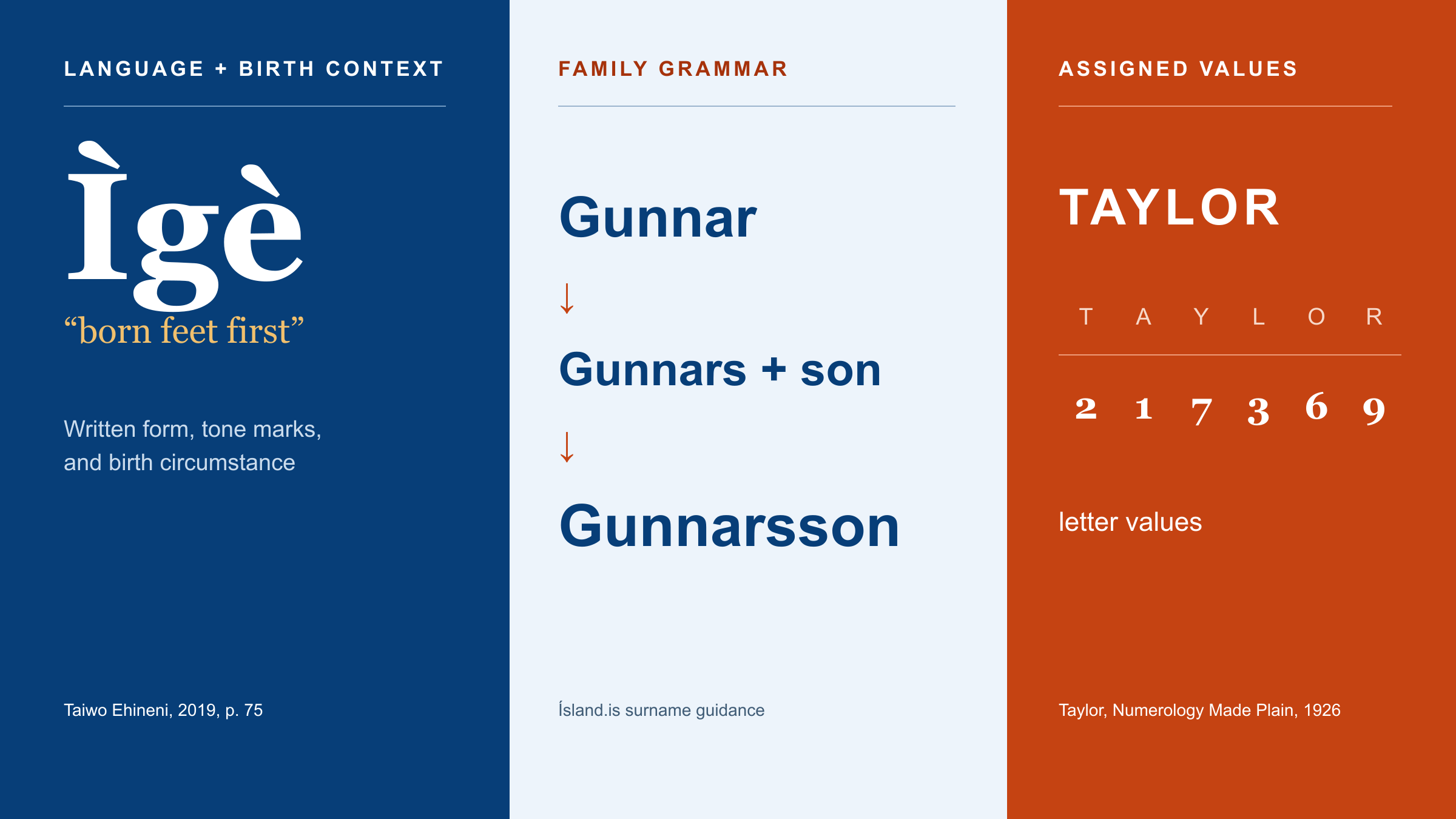
- Language and birth contextÌgè
- Source gloss
- “Born feet first”
- What the source supplies
- The spelling, tone marks, translation, and documented birth circumstance.
- Family relationshipGunnarssonGunnarGunnars + sonGunnarssonÍsland.is, current surname guidance
- Assigned letter valuesTAYLORAriel Yvon Taylor, Numerology Made Plain, 1926
Taylor converted to letter values using the table in Numerology Made Plain Letter T A Y L O R Value 2 1 7 3 6 9
Meaning starts in a language
A name dictionary often presents meaning as a short gloss beside a spelling. That format is useful for a quick lookup. It can leave out the grammar, pronunciation, history, and social setting that make the gloss intelligible.
Research on Yorùbá personal names shows how much those details matter. Yorùbá is a tonal language. Tone marks and underdots distinguish sounds and words that may look similar when their diacritics are removed. A name can have the structure of a noun phrase, a clause, a sentence, or a sequence of verbs. Shortened everyday forms may preserve only part of that larger expression.
Olanike Ola Orie’s linguistic work describes names connected to the circumstances surrounding a birth, the type of family into which a child is born, and the hopes of parents. Taiwo Ehineni’s 2019 study categorizes names associated with family situations, birth circumstances, religious orientation, death, and professions. Aderinsola Eunice Kayode’s later review also discusses birth order, seasons, important days, and historical events.
Using those categories to interpret an unfamiliar Yorùbá name requires the correct marks, the relevant variety of the language, and a source for the translation. A family’s account may also supply a reason for the choice that etymology alone cannot recover.
Names also change in use. A long form may be shortened. A religious or English name may be used in one setting and a Yorùbá name in another. Migration, official records, keyboards, and institutional forms can all affect which spelling appears. None of those versions tells a stranger how the bearer relates to the name.
Grammar can record a relationship
The Icelandic examples make a different kind of information visible. Guðrúnardóttir can be read as Guðrúnar, the genitive form of Guðrún, followed by dóttir, or daughter. The surname describes a parent-child relationship rather than passing one unchanged family label down every generation.
Current rules allow a child to use a name based on the father, the mother, or both parents. For an individual with neutral gender registration, the permitted forms include -bur, an Old Norse word referring to offspring, and the parent’s given name in the genitive without an ending. Inherited family names exist, though the government’s guidance describes them as uncommon and limited by law.
The administrative setting matters too. Iceland maintains a Personal Names Register. A name outside the register may require an application to the Personal Names Committee, and current rules address Icelandic grammatical and spelling structure. Naming practice here involves family choice, language, and law.
The surname can answer “whose son, daughter, or child?” through a documented grammatical rule. The bearer’s feelings about that relationship require biographical evidence.
Written characters add another set of choices
Ivona Barešová and Petr Janda interviewed ten Japanese and ten Taiwanese parents in 2021 about how they had named their children. This was a small qualitative study of twenty families, not a survey of national prevalence. Its interviews show the kinds of decisions that can enter a contemporary name.
Parents discussed pronunciation, associations, the meaning or image of a character, uniqueness, links to other family names, and the practical use of the name. The written form could offer several character choices for a desired sound. Parents weighed the appearance and connotations of those characters as well as how the name would be spoken.
Stroke count entered many of the Japanese accounts. The practice commonly called seimei handan evaluates combinations of strokes in the characters used for a family name and given name. Methods divide and total those strokes in different ways, then classify the results with favorable or unfavorable interpretations.
Kentarō Suzuki’s study of divination in contemporary Japan places name judgment among the methods available through books, magazines, practitioners, and commercial services. Barešová and Janda note that the stroke-count practice is often described as Chinese in origin, while scholarship they cite locates the modern Japanese method in the early twentieth century. The sources support a distinction between the practice’s modern Japanese form and broader claims about its origin.
The parents in the study used these ideas with different levels of commitment. Some wanted an auspicious count. Some checked a preferred name to avoid a result considered unfavorable. A calculation could guide the choice, settle a tie between characters, or provide reassurance after other decisions had already been made.
Birth information can enter the choice
The Taiwanese interviews described a naming practice in which a consultant works after the birth date and time are known. The consultant may consider the Eight Characters, the Five Phases, the zodiac year, and character stroke counts, then offer a set of characters from which a family can choose.
The study also records change. Most of its Taiwanese participants began choosing a name during pregnancy. None of the interviewed families used a fortune-teller to make the final choice in the traditional manner described by participants. Some used websites or books, and one waited until after birth to use birth data in an online calculation.
The interviews document birth time as one input used by a particular naming method. They also show families recognizing that method without necessarily following it. Digital tools can retain parts of a consultant’s calculation while changing who performs it and when.
The unit being counted is important. A stroke method operates on written characters. A romanized spelling is another representation and cannot be inserted into the same table as though nothing changed.
A letter-value table creates a name number
The Library of Congress holds a digitized copy of Ariel Yvon Taylor’s 1926 book Numerology Made Plain. The book assigns numerical values to letters of the English alphabet. It totals vowels, consonants, full names, and calendar birth dates, then gives those totals interpretive labels.
The book is a useful primary artifact because the operation is visible. The table defines how a letter becomes a number. The author decides which spelling and which parts of a name to count. Reduction rules turn larger totals into a smaller set of values, with special handling for some compound numbers.
Another numerology manual may use a different table, spelling rule, reduction method, or vocabulary. A nickname, married name, transliteration, or changed spelling can produce another total under the selected procedure.
Taylor’s interpretations belong to an early twentieth-century English-language occult manual. The Library of Congress record establishes the book’s date, contents, and public-domain status. It does not verify the book’s claims about character or destiny.
What happens when predictions are tested
Hung-Lin Tao used Taiwan’s 2014 Panel Study of Family Dynamics to examine claims associated with favorable and unfavorable Chinese name-stroke totals. The study considered happiness, self-reported health, marital status, education, and income.
The reported stroke classifications were not associated with happiness, health, or marital status. An initial relationship with education disappeared after controls for whether the name had been deliberately calculated and for forms of parental educational investment. Income was related to stroke luck only in a model that omitted education.
This result concerns one dataset, one classification scheme, and a defined group of outcomes. Parents may invest attention and resources in both a child’s name and education. A simple correlation between a name total and an outcome can therefore include the effects of that family behavior.
Return to the record
The Icelandic family at the beginning provides a compact example of a checkable name claim. The government’s guidance supplies the parent’s given name, its genitive form, and the permitted suffix. Those facts establish the relationship expressed by Gunnarsson or Önnudóttir under the documented convention.
The same discipline applies elsewhere in the story. Ehineni supplies the marked form Ìgè, the gloss “born feet first,” and the birth circumstance associated with the name. Taylor supplies an alphabetic table and reduction procedure. A stroke-count method must identify the written characters and its counting rule.
Gunnarsson can be checked against Icelandic grammar. A numerical personality claim about GUNNARSSON would need a different source, a stated table, a reduction rule, and an attributed interpreter.
Sources and notes
- Emilia Aldrin, “Names and Identity,” in The Oxford Handbook of Names and Naming. Reviews the often-assumed relationship between names and personal, social, and cultural identity.
- Gabriele vom Bruck and Barbara Bodenhorn, eds., An Anthropology of Names and Naming. Comparative scholarship on names, personhood, kinship, gender, and social relations.
- Olanike Ola Orie, “Yoruba Names and Gender Marking,” Anthropological Linguistics 44, no. 2 (2002). Linguistic form, social categories, and gender marking in Yorùbá names.
- Aderinsola Eunice Kayode, “The Cultural Context of Naming Systems Amongst the Yoruba of South West Nigeria,” South African Journal of Cultural History 36, no. 2 (2022).
- Taiwo Ehineni, “The Ethnopragmatics of Yoruba Personal Names,” Studies in African Languages and Cultures 53 (2019). Source for the documented naming contexts and the example Ìgè.
- Ísland.is, “Icelandic Naming Convention: Surnames.” Current surname formation, official examples, permitted endings, and family-name exceptions.
- Ísland.is, “Name Giving.” Current registration process and linguistic requirements.
- Ivona Barešová and Petr Janda, “Tradition and Change: Naming Practices in Contemporary Japan and Taiwan.” Twenty parent interviews conducted in 2021.
- Kentarō Suzuki, “Divination in Contemporary Japan,” Japanese Journal of Religious Studies 22, nos. 3–4 (1995).
- Hung-Lin Tao, “Luck of Chinese Name Strokes and Fate,” Taiwan Economic Review 47, no. 3 (2019).
- Ariel Yvon Taylor, Numerology Made Plain (1926), Library of Congress. Public-domain primary artifact showing alphabetic and birth-date calculations.